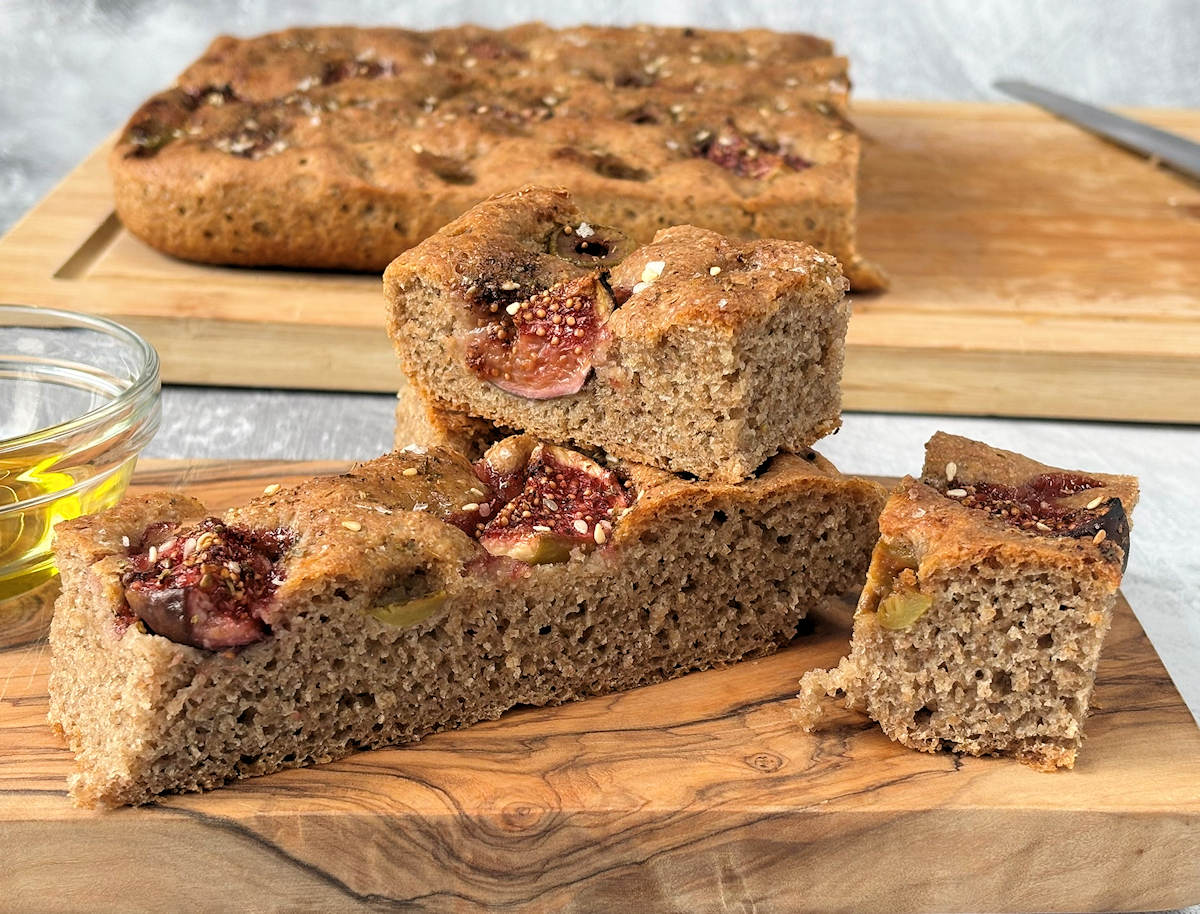
Earthy rye, sweet figs, salty olives and a sprinkle of za’atar. Focaccia, a little out of the ordinary.
Focaccia: not as you know it
Here’s an unusual kind of focaccia made with wholemeal rye flour. Focaccia di segale, rye focaccia is a much less common, though not unheard of variation on the Italian bread. It is quite unlike the usual, undulating slab drenched in olive oil, aerated and pillowy, which requires a strong gluten network and a dough of high hydration.
Wholemeal, also sometimes called dark rye flour contains a different kind of gluten to that in wheat: it doesn’t form elastic protein network supporting the dough.
In this recipe some wheat flour helps form the gluten matrix. And instead of just mix, shape and leave the dough as you would an all-rye one, the supporting character of the wheat flour does some work and gets boosted by some kneading and folding.
How to make the dough
Both flours roughly mixed with water – with a couple of tablespoons reserved to blend yeast into – should be left to stand for half an hour or so. In an all-wheat dough or sourdough this is the autolyse stage which helps develop gluten network.
Here it mainly serves to hydrate the flour as rye, as we already said, has a different kind of gluten. This stage can be skipped if time is pressing though it does add to the bread’s strength.
The original recipe from Great British Chefs advises using fresh yeast which is great to work with but less common in home bakers. If you skip the hydration, add instant yeast straight to the flour. If you do hydrate, bloom the yeast in a little reserved water for a few minutes, then add it to the dough with the olive oil.
As with mostly rye doughs, kneading or mixing with a machine is necessary only up to the point when the dough is smooth and elastic, no windowpane tests here. By the end of the kneading/mixing add the salt, and off it goes to prove for about an hour.
Macerating figs
Again, not an essential step but a nice-to-do one: marinating fig chunks in honey and balsamic vinegar. Slightly less ripe, less jammy figs will work better here, baking nicely without turning mushy.
Cut them into quarters or sixths, depending on their size, and soak in the honey-balsamic mixture while the dough is being prepared. I also bung the olives into the marinade, so the flavours can mingle.
Folding
After the first rise, give the dough a fold or two: grabbing it through the middle, let the ends fold underneath. Repeat until the dough has coiled and tightened, then leave it for half an hour again.
Shaping
There is not much shaping to speak of in this recipe. Simply form the proven dough into an oval loaf and place in an oiled tray. Tuck around the edges to tighten a bit and leave for another half an hour. This time it should rise appreciably.
Dimples and toppings
The most pleasant part in making focaccia is making the dimples in the risen dough with oiled fingertips.
At this point you can drizzle the dough with more olive oil before pressing the olives and fig chunks into the surface. Don’t stress about draining them from the marinade: a little of it pooled in the dimples will enhance the flavours.
It’s now ready for the final proof while the oven heats up. If you own a baking steel or stone, set it up on the middle rack – it will help the focaccia bottom bake better.
Baking and storing
When the dough has risen to the rim of the tray, it’s ready to bake. Rye dough does not have much of an oven spring (the rapid rise at the start of the baking) so what goes in, comes out.
You can gently press the dough to check whether it’s ready: if it springs back, it needs longer and if it hardly rises back at all, it’s good to go (if it stays dented, it’s overproved and likely to be an inferior result. Still, it will be homemade bread and thus better than many a shop-bought loaf).
Sprinkle it generously with za’atar and flaky salt, more olive oil and transfer to the oven for about half an hour. If you’re not using a stone or steel, have a careful peek underneath to see if it’s browning, using a palette knife. Sometimes a focaccia is glossy and golden on top and insipidly pale and underbaked underneath.
When it’s out, cool it slightly, give it another misting of oil and you can tuck in. It will keep for a day but any longer than that, any leftovers need to be frozen, due to the fresh fig content. Cut into slices, they will be very good defrosted overnight.
More focaccia recipes
Plain focaccia with rosemary and salt flakes; easy to make, divine to eat, warm or cold. Authentic Ligurian recipe from Samin Nosrat’s Salt, Acid, Fat, Heat.
Grape and blue cheese focaccia flavoured with dried oregano. The savoury version of the Tuscan bread schiacciata con l’uva, easy flat bread with olive oil, fresh grapes and crumbled blue cheese; which might be swapped for goats cheese if preferred.
Blueberry focaccia which is really dessert: enriched focaccia dough topped with juicy blueberries and buttery crumble. Easy to make, perfect warm with coffee for breakfast, brunch or afternoon tea.
More rye bread recipes
Sourdough light rye bread with yoghurt, made with wheat sourdough starter. Light rye yoghurt sourdough, healthy and tasty, with whole rye grain and linseed.
Scalded rye and honey loaf with a hint of cinnamon. Scalding flour works as dough enhancer, softening the crumb and prolonging the life of a loaf.
Borodinsky bread is Russian rye sourdough, with its history going back to Napoleonic wars. Great for gut health, this rye sourdough loaf is named after the battle of Borodino.