You know spring rolls, everyone’s favourite starter in a Chinese or Thai restaurant? Now you can have them for dessert too!
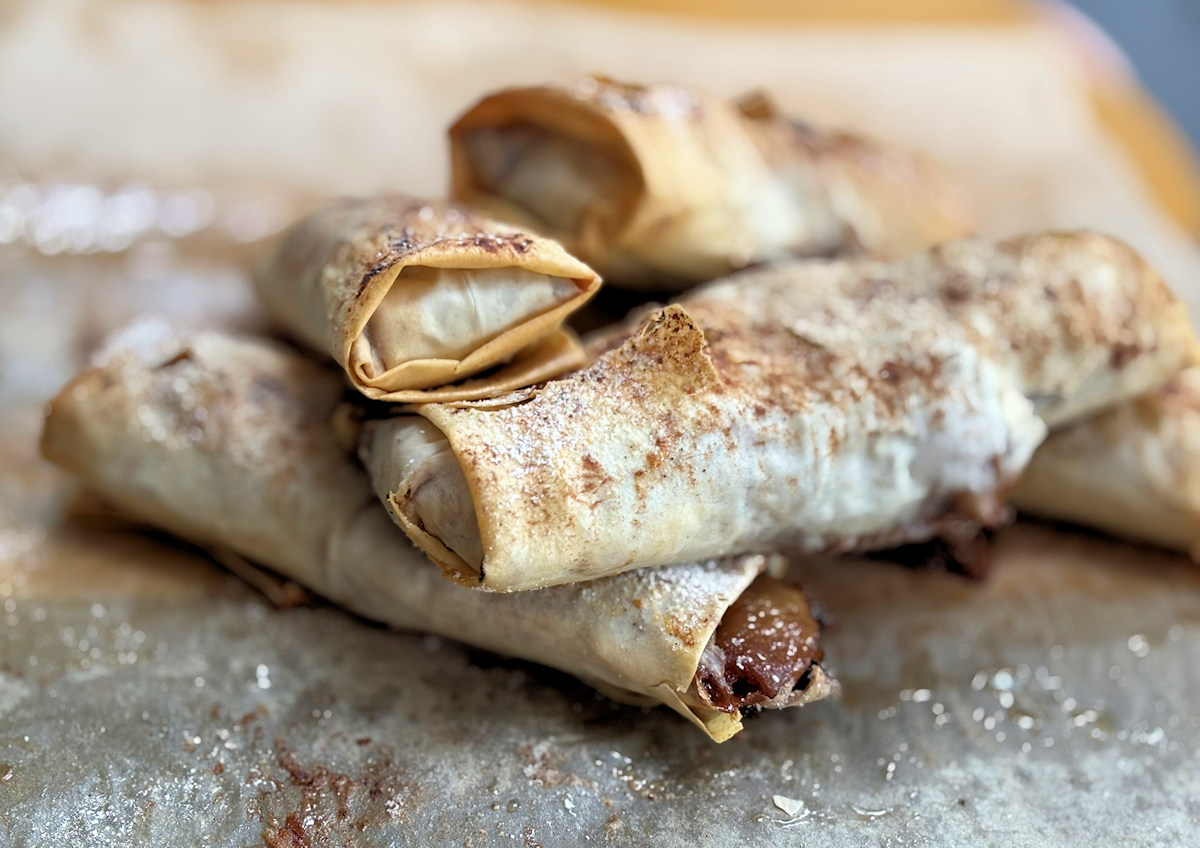
Spring rolls for pudding
That’s not a joke: the delightful Thai restaurant chain, Giggling Squid, features them on their current menu. Thai apple pie spring rolls are crunchy pastries filled with apples. I ordered them, The Weather Man as usual devoured a lion’s share, and we were both smitten.
The idea is brilliant, albeit not so new: see MaccyD’s apple pies, Greggs’ (sadly discontinued) apple turnovers and – to considerably elevate the company – German apple strudel.
The last is a work of art, with the dough famously rolled and stretched thin enough to let you read love letters through it. Greggs turnovers were encased in puff pastry, while heaven only knows what the McDonalds pies are made from.
Puff, rice paper or filo?
Giggling Squid pastries are most probably made with rice paper, considering they are called ‘spring rolls’, except instead of duck or prawns there is sweet apple filling in them and they are showered with icing sugar and cinnamon.
So since I didn’t want to deep fry my rolls, balked at the richness and calories in puff pastry and hadn’t received any love letter lately to inspire a strudel action, I picked filo. Just like rice paper, but bakeable.
What apples for pastry filling?
Contrary to their name, cooking apples are not the best to make apple filling. They are brilliant for apple sauce or jam as they cook to a mushy softness, but for the rolls we want apples that will hold their shape. The filling is likely to try to escape through cracks in the pastry as it is.
Any apples you like to eat will be good to use here, like with wine used in cooking: it should be good enough to drink too. I like Coxes but some people swear by Pink Ladies. Whichever native apples are in season, go for those, for the principle.
Preparing apple filling
Peeling the apples is non-negotiable. I know, the fibre in the skin makes you want to add a redeeming element to a sweet treat, but it will ruin it. Skins will be tough, the filling won’t be smooth and this is dessert not health food anyway.
Peeled and cored, the apples may be chopped chunkily or smaller, as you prefer. I like them cut into short thin slices or else diced.
Tossed with sugar and more spice than you thought sensible, they should sit for half an hour to macerate and release the juice. It will mean they won’t release more juice, and thus make the pastry soggy, whilst baking.
I like to add a handful of raisins or sultanas, just for extra indulgence but it’s optional.
Cooking apples
With a chunk of butter foaming in a frying or sauté pan, the apples and all the juices will cook until softened and reduced which, depending on the variety, will take ten to twenty minutes. The apples should be soft and wilted but not mushy, and all the liquid cooked off.
After they’ve cooled down, stir a spoonful of cornflour through them, to thicken a bit further.
Thus prepared, the apple filling will last in the fridge up to 5 days so it can be made well ahead.
And the very same filling is great for pies, strudel, crumbles and any other apple desserts you like.
Preparing filo rolls
Filo pastry is unduly renowned for being difficult to handle – it really isn’t that hard. If you leave it uncovered on the worktop - sure, it will dry out and crumble. But if you keep the sheets, processed and yet to be used, covered with a tea towel and work reasonably briskly, nothing bad will happen.
Filo can be brushed with neutral oil or butter, whichever is your choice, with the latter making it crispier.
Have the melted butter at hand with a pastry brush, place a sheet of pastry on the worktop or a large chopping or pastry board, and brush it all over with butter. You can brush both sides or just the inside, and dabble butter on the dry side as you roll.
Don’t overload the rolls: the filling is delicious but the rolls will keep better, be crunchier and more pastry-like if there is only a small amount of apple inside, about a tablespoon lined up at the shorter end.
Roll it some way up, then fold the sides over and continue to form a tidy roll.
Brush with more butter and place on a baking tray, covering it with a towel as you shape each following roll.
Baking and reheating
Once they are all shaped, use up any leftover butter to give them a final dab, sprinkle with icing sugar and cinnamon and bake for about half an hour until crisp and golden.
And that’s when they are the best served, with ice cream or whipped cream. They will keep quite well in the fridge though, in an airtight tub lined with parchment, for up to five days. But don’t serve them cold – that’s a crime against these pastries. Warm them up for fifteen minutes in a hot oven, and they will be as good as fresh.
More apple dessert recipes
Apple crumble is the easiest and nicest autumn dessert, put together in a few minutes and baked in half an hour. Apples and rum-steeped raisins covered with oat and cinnamon crumble are the perfect weekend afternoon treat.
Rustic apple galette is the French take on apple baking, with a shortcrust pastry base and sliced raw apple filling. There’s no blind baking, no precooking apples – and no soggy bottom!
Honey cake with dates and apples from Nigella Lawson’s collection is not only suitable for Rosh Hashanah: it’s simply the perfect autumnal cake.
More filo pastry recipes
Ottolenghi inspired fondue filo pie, with butternut squash swapped for mushrooms. It’s a combo of Savoyard raclette experience and a Greek or Middle Eastern filo pastry, and it’s excellent.
Athens mess, or Eton mess goes to Greece: fresh blueberries and strawberries, lightly whipped cream and filo pastry brittle. You’ll never want the meringue version again!
Filo pastry parcels coiled into snails, with vegetarian filling made with mushrooms and spinach. Dainty parcels or little pies, coiled in shape of snails look interesting and taste wonderful. You can also add feta, ricotta or mozzarella to the filling mix.