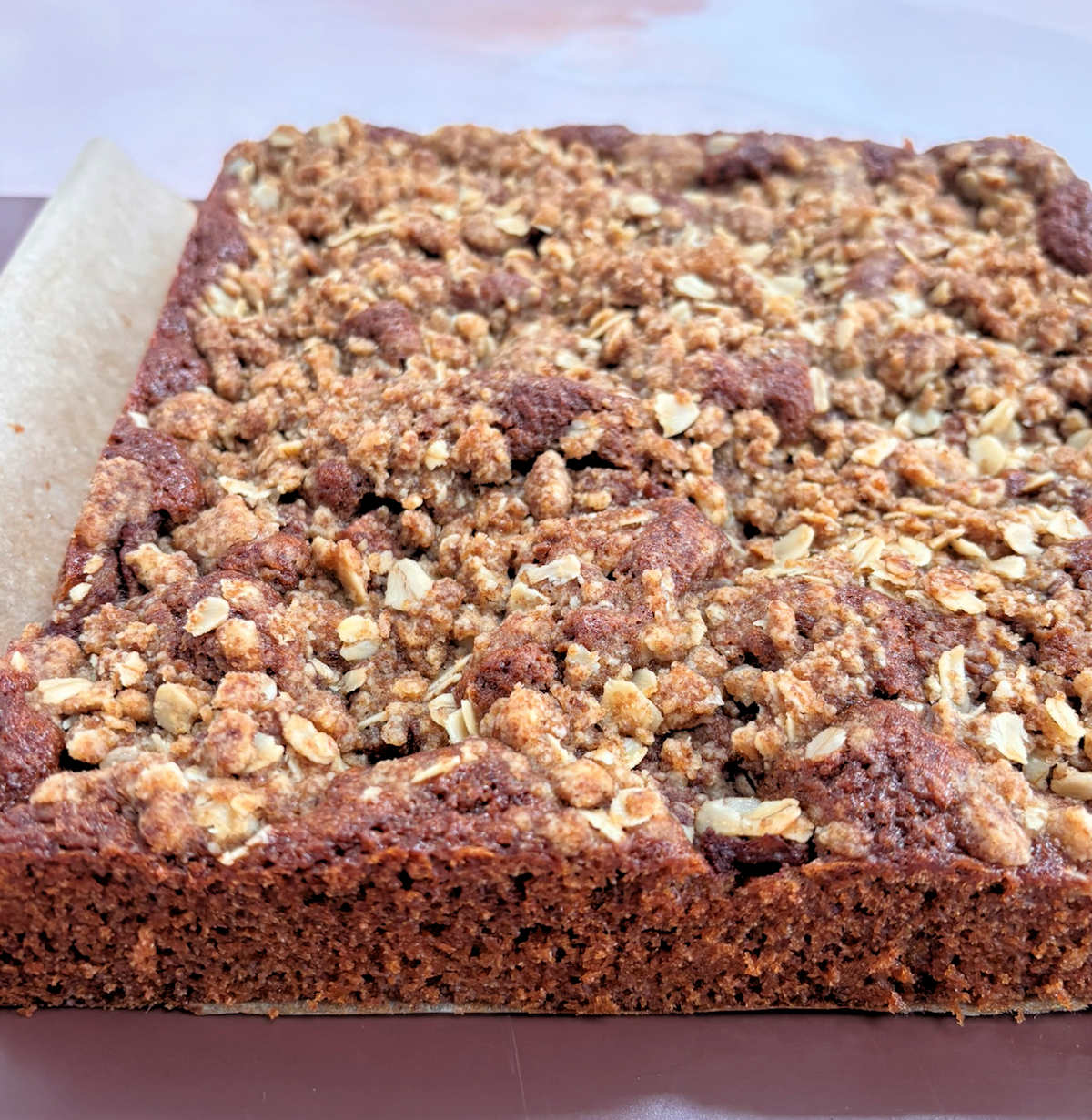
Delicious apple cake with spiced, cooked apple chunks half-sunk into easy cinnamony sponge, topped with brown sugar and oat crumble.
So many apple cakes
I think apples must be the most versatile baking material: the array of apple cake and bake recipes is dizzying. Starting with the simplest, there’s English apple crumble, and who doesn’t love both to make and to eat it?
There is the classic American apple pie with shortcrust pastry and generous filling. The French have a Tarte Tatin and a rustic galette. In Germany there’s yeast-raised Apfelkuchen and in Austria: Apfelstrudel.
Polish szarlotka is similar to the American pie but usually baked in rectangular trays. There are Scandinavian apple cakes, or rather epplekake or äppelkaka.
There even is a Japanese apple cake called an invisible cake because it’s made of many thin layers of apples bound with very little batter. You could practically go around the world eating only apple cake! (Possibly.)
What varieties of apples are best for baking?
In the UK Bramley apples are also called ‘cooking’ apples so you might think it’s a no brainer: just go for Bramleys for all your baking needs, right?
Not so simple, and in fact quite the contrary. Cooking apples are the very soft kind that will happily collapse into jam because they break down when exposed to heat. So for an apple crumble, if you want it fluffy and puréed underneath the topping, for a mousse or compote or for a dish of stewed apples Bramleys will be ideal.
If you want however to keep the apple chunks in their shape, only softened and wilted, choose ‘eating’ apples. And then depending on whether you want a tart flavour or meltingly sweet, choose the right variety. Granny Smith, Cox or Braeburn are sharper and tangier, while Russet, Jazz or Pink Lady are mild and sweet.
How to cook the apples for the cake?
I do prefer apple cakes with cooked apples – there are no surprises in the form of apples releasing lots of juice and ruining the base, or turning into mush and almost dissolving.
For this cake, which follows a recipe from New York Times Cooking, do pick Granny Smith, Golden Delicious or Coxes: as said above, those varieties will retain their shape when cooked. Don’t go near Bramleys: they’ll turn into a purée.
The apples, peeled, cored, quartered and sliced not particularly thinly should be cooked gently with a little brown sugar, butter and lots of cinnamon. Don’t cover the saucepan: you want them to soften rather than release juices.
Stirring often, it will take about ten to fifteen minutes for the apples to wilt and slightly caramelise. Make sure you do this a little ahead, as they’ll need to cool down before being added to the cake.
The oat crumble
While the apples are cooling, you can make the crumble and then the sponge batter.
The crumble is straightforward: soft butter mashed into the mix of flour, sugar and oats. You can do that with a spoon, a fork or just fingers. When it starts clumping, it’s ready so set it aside while mixing the batter.
How to make the cake batter?
And the batter is even easier to make. All the dry ingredients are stirred together in a bowl while the liquids including eggs, soured cream and oil are whisked in another bowl or a jug.
Then it just needs to be combined into smooth batter, with a whisk or a spatula – but there is absolutely no need for any electric appliances to be engaged.
How to assemble the cake?
The batter goes to the bottom of the prepared tin, square or round, buttered and/or lined with parchment.
The apples will be a little awkward to spread over the batter because they’ll want to clump into big lumps and sink to the bottom of the tin. It doesn’t matter too much as the cake may still be delicious, but try to spread the apple pieces more or less evenly, to avoid apple-less portions. Sinking is fine – the batter will rise in places as the cake bakes anyway.
With the crumble scattered on top of the apples, the whole cake now goes into the oven for about forty minutes. The surface might look like mini volcanic eruptions but it’s all fine.
When a skewer prodding the middle comes out dry, the cake is ready to come out, cool a little and be greedily devoured with clotted cream or vanilla ice cream. It will be still lovely a day later too, cut neatly into squares and stored in the kitchen, loosely covered with a clean tea towel.
More apple recipes
Apple crumble is the easiest and nicest autumn dessert, put together in a few minutes and baked in half an hour. Apples and rum-steeped raisins covered with oat and cinnamon crumble are the perfect weekend afternoon treat.
Apple marmalade, thick and gorgeous spiced apple preserve with natural pectin. If it’s never jam today, perhaps we can have some marmalade, eh?
My apple pie is a cross between American and English pie versions. The perfect apple pie with sweetened shortcrust pastry and tart fresh apple filling - the best apple pie recipe I’ve tested. It’s totally worth it to make pastry from scratch.
More autumnal cake recipes
Easy and delicious plum cake featuring ripe Victoria plums on top of a tender sponge base, gently spiced with cinnamon for a classic autumn treat. Discover why plums deserve a starring role in seasonal baking and how to make the perfect fruit-topped cake with simple ingredients and expert tips from a British kitchen.
Honey cake with dates and apples from Nigella Lawson’s collection is not only suitable for Rosh Hashanah: it’s simply the perfect autumnal cake.
Sticky pear and ginger cake is dark, moist and incredibly easy to make. With juicy chunks of pears and crunchy pecans scattered over the sticky syrupy surface, it’s the perfect autumn dessert.