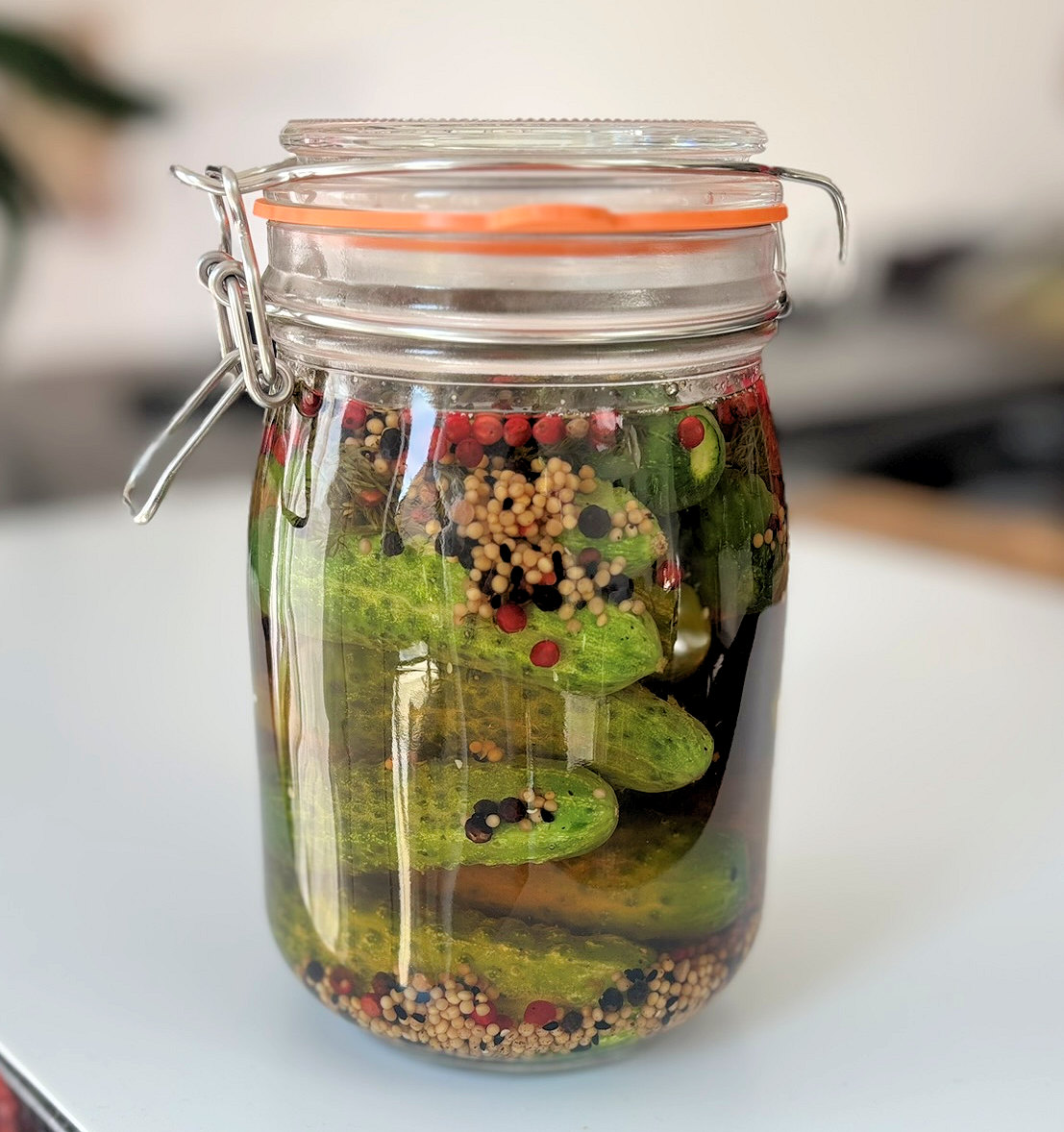
Easy pickled gherkins are crisp, tangy baby cucumbers preserved in a simple cider vinegar brine with dill, mustard seeds and peppercorns – ready in days and far better than shop-bought jars.
The many cucumber varieties
They are delicious, quick and easy. The only difficulty is in procuring those tiny knobbly cukes.
I bemoan the fact that in the UK the overwhelmingly common variety of cucumber is the most boring and the least tasty: the long and smooth greenhouse Telegraph.
There also are slightly more flavourful, outdoor grown ridge cucumbers, but if you want small ones that are suitable for pickling as well as taste better, you have to hunt ethnic market stalls or pay through the nose for tiny punnets of so called ‘baby cucumbers’.
Those small ones are usually the Kirby or Persian varieties though sometimes, when buying plants for garden cultivation, you can see them labelled simply as ‘gherkin’ variety, even though the word commonly means pickles. And that’s probably the best way of getting hold of good small cukes for pickles: growing your own in a home garden or an allotment.
And they are not hard to grow. This recipe was born from a bumper crop yield from a single garden plant!
Cool as a cucumber
They are botanical fruit, similarly to tomatoes, though considered a vegetable in the kitchen. The saying ‘cool as a cucumber’ has some grounds in the facts because, being mostly water, cucumber flesh tends to have internal temperature lower than ambient.
And they are sometimes bitter, if grown in too hot weather or with insufficient watering. The bitter compounds (cucurbitacins) tend to cumulate in the stem end of the cucumber, but the belief that you should peel them always from the other, blossom end not to spread the bitterness is a myth.
Cucumbers in history
Of course, Romans knew and loved them, including Emperor Tiberius who ate them daily. They are a truly global plant, born in the Indian subcontinent and spread to the Middle East and Egypt as well as eastwards to China and Japan. And for once, cucumbers were something that Columbus introduced to the Americas, instead of only importing new species into Europe!
Over centuries breeding produced less bitter and more flavoursome varieties. Why oh why then all we have in the British Isles are the long bland monsters that go off so fast they have to be encased in plastic?
Pickling the road to discovery
But all criticism aside, cucumbers are highly perishable vegetables, going off within days, even if freshly picked and stored in the fridge.
Hence, pickling them has been a method of preserving this food since ancient times. Keeping vegetables in a salty or acidic solution stops harmful bacteria and mould, thus letting us enjoy more fragile vegetables longer.
Pickling and canning developed fully in the industrial era, and the health benefits of pickles, kimchi and sauerkraut are not restricted to saving sailors at sea from scurvy.
How to make the pickling brine?
There are plenty of pickling recipes around and a lot are quite complicated, instructing to salt the cucumbers or soak them for hours before boiling in the pickling liquor. But the way to your gherkins need not be so winding.
I followed the Great British Chefs with minor tweaks. Wash the cucumbers in cold water, pat them dry and pack into sterilised jars.
The pickling brine aka liquor (though it’s not booze) is seasoned with mustard seeds, peppercorns and dill. The peppercorns can be just black or mixed with pink and/or white, for the aesthetics. Dill should generally be the flowering heads rather than limp fronds sold in the shops but the former are hard to come by – just like small cucumbers. In which case we need to use the dill fronds, and the pickles will simply be not quite as dill-fragrant.
The brine or liquor should be brought to the boil, then cooled a little. Depending on whether the pickles are for quick consumption or for long storage, you can use hot brine in case of the former, and cooled to room temperature in the latter.
The cucumbers should be covered with the pickling liquor and the jar can be sealed straight away. If made with hot brine, the pickles will be ready in a matter of days but need to be stored in the fridge, once opened. Cold pickling means waiting for about two weeks at room temperature.
More cucumber recipes
Fresh cucumbers with cumin tahini dressing, sprinkled with extra sesame seeds are crunchy, juicy and wonderfully refreshing. Try them as a side for beef burger patties.
Chinese smashed cucumber salad with rice vinegar. Make this Asian smashed cucumbers salad as spicy as you like with chili flakes or red pepper flakes.
Stir-fried cucumbers Asian style, with ginger, garlic and a pinch of chilli. Spicy but also refreshing which is logical as cukes are 96% water.
More pickles recipes
Lightly fermented cucumbers are the healthier pickles, crunchy and delicious. Quick lacto-fermented baby cucumbers in lightly salted brine are an excellent probiotic food, good for the gut and wonderfully tasty.
Flash pickles made with cucumber and carrot slices. These quick refrigerator pickles are ready in 3 hours and keep more nutritious elements than ordinary pickles.
Know your onions – and pickle them. Quick, easy and vibrant pickled red onions, perfect for a taco or burger night.