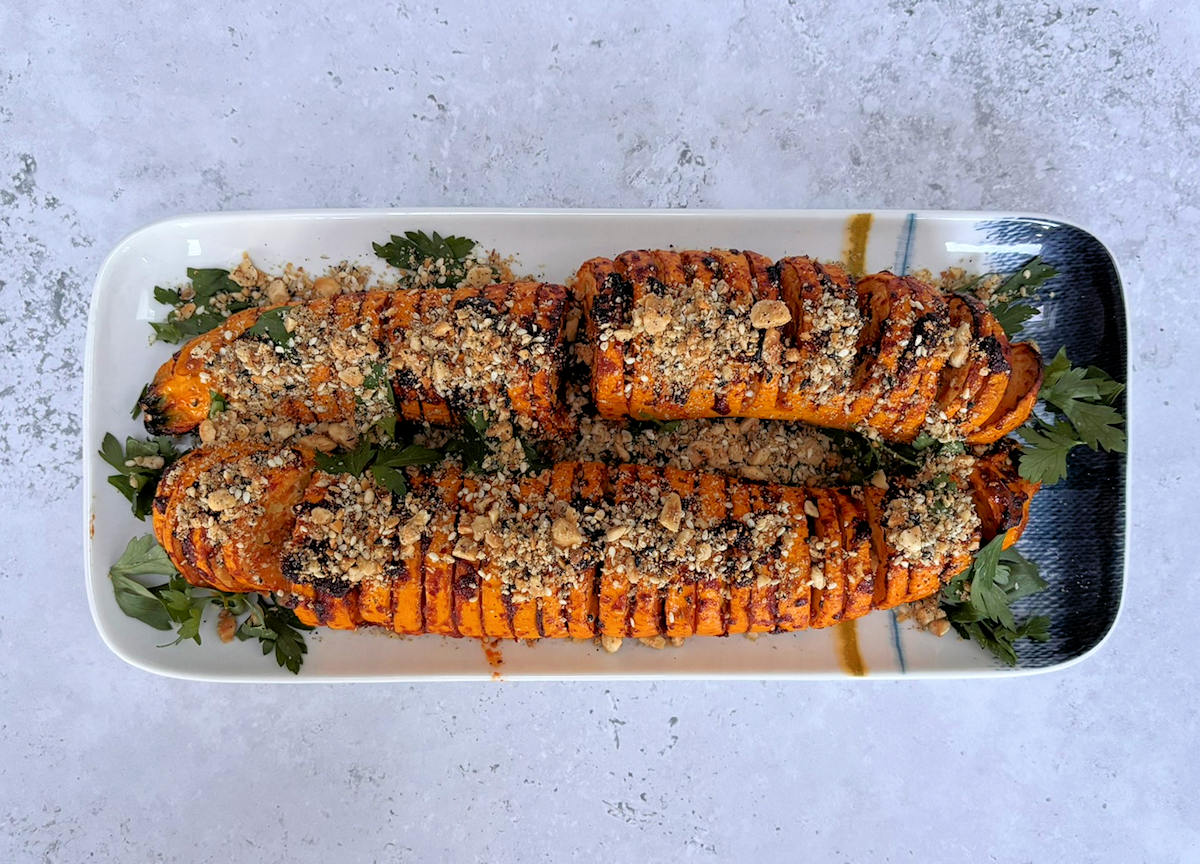
From the infamously boring vegetable to an impressive centrepiece: hasselback courgette with harissa and dukkah topping. Also, delicious.
What is hasselback?
Hasselback is a fancy method of preparing a vegetable for cooking, by making cuts into it but not all the way through, so it’s a fan of slices held together at the bottom.
It was invented in Sweden, in a Stockholm restaurant called Hasselbacken, in the 1940s. Since then the method became popular all over the world, especially in various cheffy contests.
It was originally and still is most commonly potatoes that are subjected to hasselbacking. By cutting them into almost-slices and then rubbing with lots of butter and seasoning, the spuds become many times as crispy and much more flavoursome when baked.
But potato is not the only hasselbackeable vegetable, as the recipe here shows. You can bake or roast aubergines or squashes like this too. And we don’t stop at veg – doesn’t hasselback chorizo sound appealing?
How to hasselback?
The trick of course is not to cut through – or it’s a fail. Although I’ll admit I had such a fail while testing the courgette recipe and in order to salvage it, I stuck the two halves together for baking with a toothpick. What do you know? It worked.
Better take care though, and the best tip is to line chopsticks or wooden spoons alongside the courgette, something to stop your knife when it cuts into it. Then handle it carefully so it doesn’t break after all that care you took while cutting.
Harissa - bold flavours for a bland courgette
You can roast the courgettes thus prepared seasoned with only salt, pepper and brushed with olive oil – they’ll be impressively ridged. But as we know, strong flavour is not courgette’s forte so it will benefit from some zing, oomph and a kick. What’s better for that than harissa?
It is mixed with olive oil and lemon juice, as per the Great British Chefs recipe, and I like to add a little sweetness as well to the marinade.
Brush or rub it on carefully again, but it’s good to make sure the marinade goes into all the crevasses. For that, you can use a pastry brush.
Roast the courgettes for about half an hour to forty minutes, depending on their size. I like the large yellow ones for this recipe but the ordinary green ones are very good to use too.
Dukkah topping – make double the amount!
Dukkah is a Middle Eastern and Egyptian condiment, used as a dip or a topping on anything you like including bread. It’s generally a mix of herbs, seeds and nuts but the ingredients vary. In this instance it’s hazelnuts with black and white sesame seeds, cumin and coriander.
That mix should be toasted in a dry pan until amazingly fragrant, then pounded in a pestle and mortar with some salt and pepper. Arguably it’s possible to use a blender or a spice mill instead, as long as the mix is chunky, not pulverised.
And it’s such a gorgeous topping, I promise you’ll regret not having made twice the amount. Especially that it keeps well in an airtight container, in a cupboard.
How to serve hasselback courgettes?
Serve them hot or at room temperature, sprinkled profusely with dukkah. It is a genius vegan starter dish for a dinner party, easy to prepare in advance. It is also an impressive side, but if you have some fresh bread with it (to dip in the extra bowl of dukkah), it’s a good standalone lunch or light supper.
More courgette recipes
Caramelised courgettes with basil and garlic: is it a sauce, a condiment, a side dish? All of those and more.
Courgette fritters without grating, courgette slices fried in spicy coating. Courgette fritters in tomato and paprika cornmeal coating are a great side dish or a perfect snack or starter.
Raw courgette ribbons marinated with lemon and tossed with raisins, almonds, pistachios and nori flakes – a gorgeous courgette salad made without a spiralizer but with just a vegetable peeler.
More vegetable centrepiece recipes
Five-spice butternut squash in cheesy custard, with orange rayu (Japanese chilli oil) is precisely the treatment the squash needs to be a great dish. No surprise, it’s a recipe from Ottolenghi.
Vegetarian Wellington, with mushroom and spinach layer around baked celeriac centre. Easy to make ahead, even easier to make it vegan using vegan pastry and omitting the butter.
Salt baked celeriac, sweet and earthy and a Michelin grade impressive centrepiece dish. Salt crust dough made from flavoured salt and flour, you crack it open like an enormous soft boiled egg. Or a pathologist opening the skull.