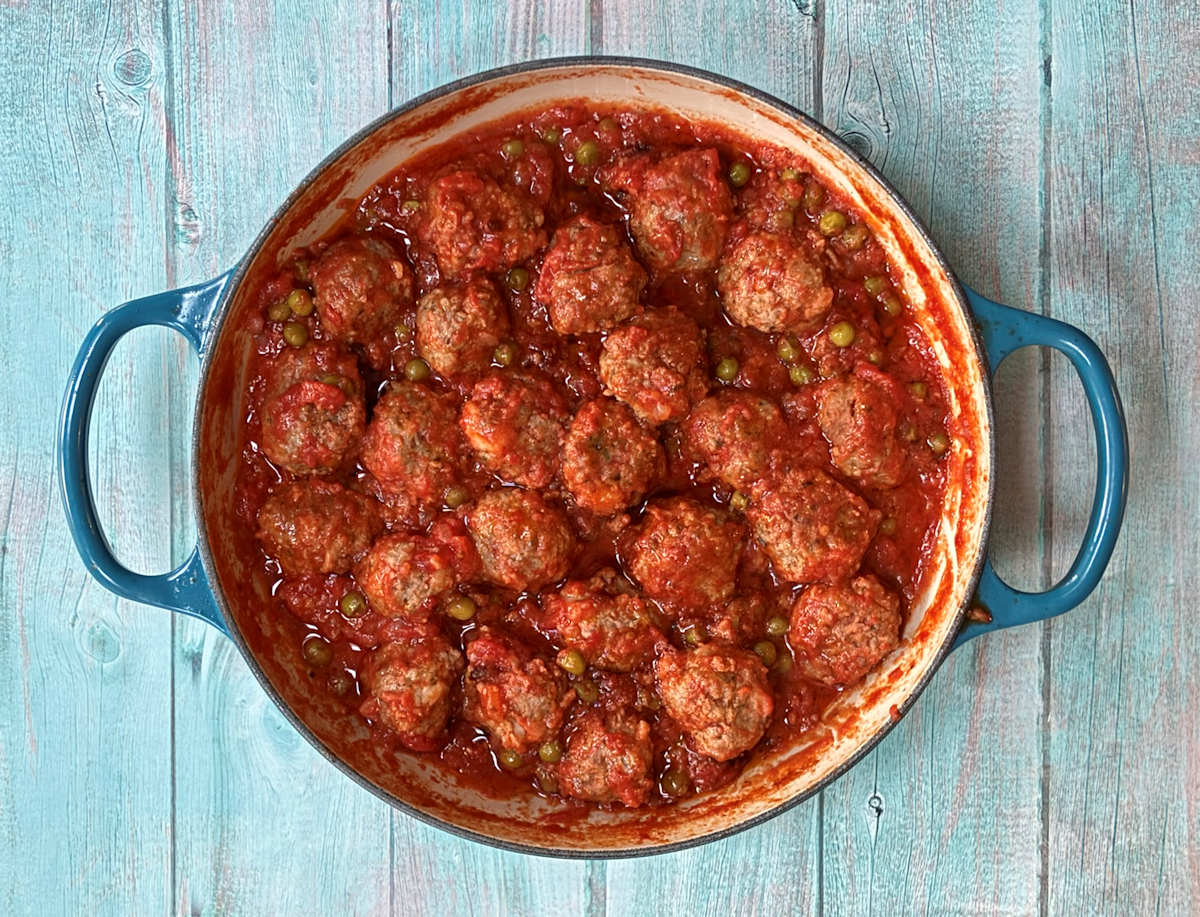
Meatballs in tomato sauce, Italian style, are one of the greatest comfort foods of all. And this recipe is an absolute winner, as you make the sauce in the same pan you cook the meatballs in.
The comfort factor
The comfort factor of food is undeniable: eating tasty things improves our mood, warms us up and settles our anxieties or worries. It’s usually ‘something a little bit tasty’ and commonly, unfortunately for our health and weight issues, loaded with calories, fat and carbs.
It’s all about dopamine, you see! Dopamine and serotonin are neurotransmitters and sometimes called ‘happy hormones’ (though strictly not hormones as such) that are released by our nervous system to signal pleasure, satisfaction and reward to our brain.
But not the same foods have the same effect on everyone as, apart from the ‘tasty’, there is a nostalgia value to what we eat and how it makes us feel. Some foods (like madeleines for M. Proust) take us back to when we felt safe and cared for, not necessarily always but often meaning childhood. Which explains the value of the ‘like Mum’s (or Nonna’s) cooking’ in hospitality marketing.
Comfort foods worldwide
It’s interesting to compare and contrast what makes a comfort food across the world. The main differentiating factor will obviously be the climate and the second most important: locally available ingredients. Thus a dish of bigos, braised sauerkraut with meats, will be a commonly beloved in Poland but not so much in Japan where they prefer a miso soup. Rice and beans will cut the mustard in South America while the Italians turn to gnocchi.
Of course there are similarities: local versions of almost the same dishes found in different parts of the world. Soups are always comforting, be it ramen or zurek, as well as starchy foods like colcannon or tartiflette.
And when it comes to meat featured in comfort dishes, mince rules supreme. It might be due to the childhood associations - minced meat fed to toddlers, it could be thanks to the digestive ease or to the fact that it’s cheap and cheerful. But either way, meatballs and meatloaves are welcome world round with a happy sigh. Unless served to vegetarians.
How to make the Italian meatballs
The Italian way is generally to mix minced beef and pork, and very wisely too as that ensures the correct fat content from pork and the flavour from the beef. My local butcher sells ready-mixed ‘Italian’ mince which is handy, but buying a pack of each and putting them together requires no effort whatsoever.
Seasoning, here some garlic and dried herbs, is simple, but what’s important is the non-meat content. The best meatballs contain less than 70% meat! Slightly stale, milk-soaked bread is essential, as is grated Parmesan. Both make the meatballs tender and succulent, and provide the comfort factor.
The pulp is best mixed by hand, and shaping the balls, which I like golf ball-sized, should be done with wet hands.
How to cook the meatballs in the sauce
This recipe is courtesy of Great Italian Chefs, a branch of the mighty inspirational platform Great British Chefs. And it’s truly ingenious, at least as far as the cooking method goes.
Usually we shape the meatballs, and proceed to cook the sauce. Then frying the meatballs in another pan fills the kitchen with not-so-savoury smells and the sink with dirty pans. And only at the end the meat lands in the sauce to mingle the flavours and create the actual dish.
This is much simpler. Only one, albeit the largest you have, sauté or frying pan is needed whereby finely chopped onion is sweated. Meatballs go into the onion, turned over every now and then to cook uniformly on all sides. True, they won’t be crispy-fried but I never understand the point of doing that if they end up soggy in the sauce anyway.
Once cooked almost through, the wine is added to deglaze the pan.
Next in, a tin of tomatoes and some tomato puree to taste, and the dish simmers gently for a while for the sauce to thicken. One pan, which incidentally can be served hob to table, for the diners to ladle the meatballs onto their pasta or rice-piled plates.
Peas option
And I believe you’ll be in no breach of Italian cookery rules if you add some frozen peas to the sauce, to boost the plant/fibre content. And they will make it look more vibrant too.
I expect diced carrots can be used as well, or go the whole hog and empty a packet of frozen soffritto (mirepoix) in there.
More meatball recipes
Beef, ricotta and oregano meatballs from Ottolenghi are delicate and light, cooked in a richly flavoured tomato and onion sauce.
Korean BBQ-style oven baked meatballs with sweet and salty glaze, super easy and mega tasty. With old fashioned Ritz crackers to bulk out the beef mix!
Pork and smoky bacon meatballs with tomato flavoured bulgur wheat, a variation of Swedish, Italian and Moroccan meatball classics.
More comfort food recipes
Cold evenings mean casseroles, the warmth from the oven and the rich scent filling the kitchen. Venison casserole with mushrooms and red wine, cooked slowly, delivers tender and succulent meat with the flavour of juniper, thyme and the wind.
Traditional lasagne with ragù sauce and white béchamel sauce, between four layers of dried pasta sheets. Make sure you make a batch for the freezer!
Best mac n cheese with leeks - elbow pasta with braised sliced leeks baked in cheesy creamy sauce. Macaroni cheese is sometimes called pasta Mornay, the cheese sauce. It's a simple vegetarian pasta bake and ultimate comfort food.