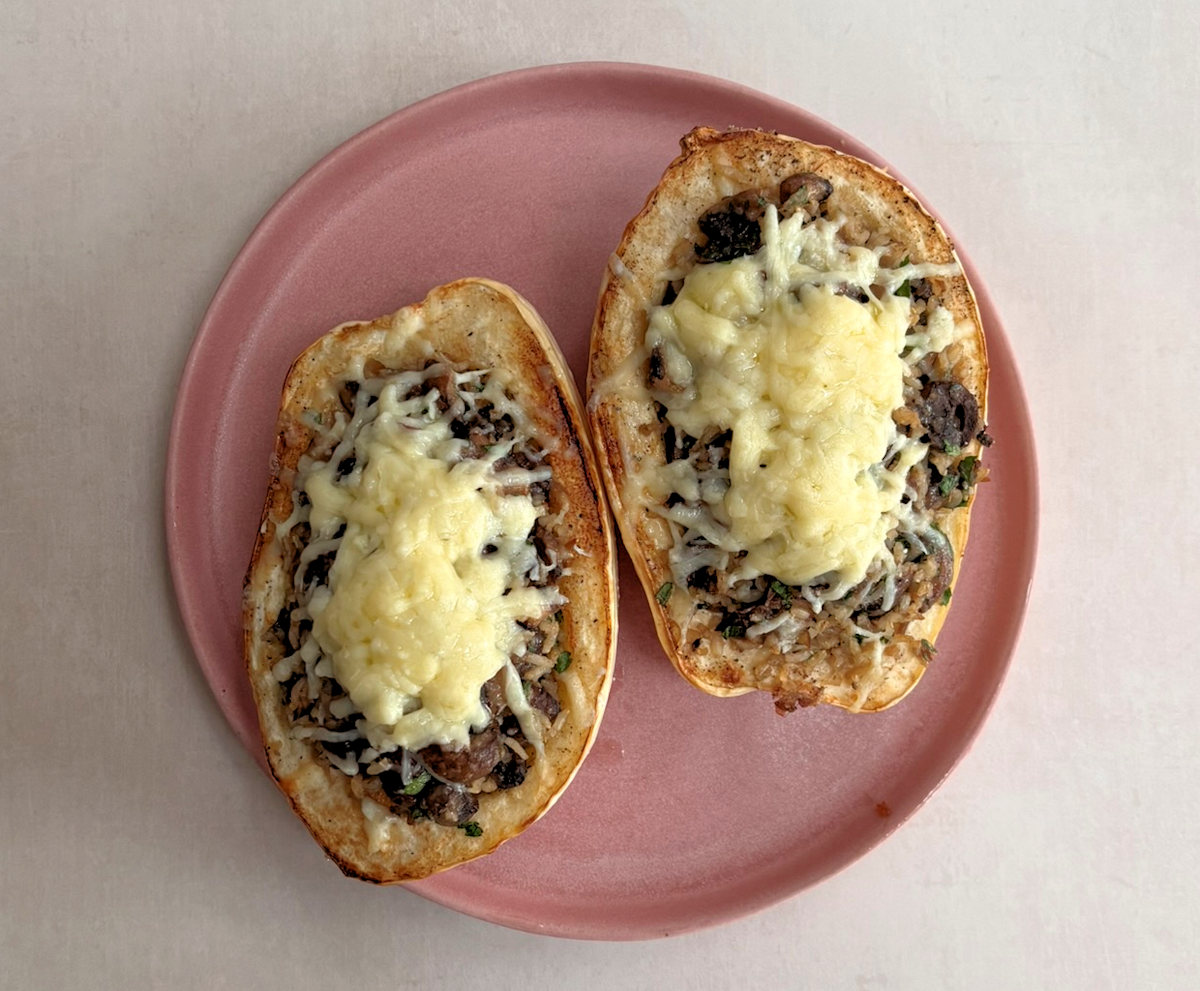
Acorn squash stuffed with mushrooms and topped with melty cheese – that’s a lovely autumnal vegetarian supper.
Squash varieties
Did you know that courgette is a squash too? It is a type of summer squash and not, as many think (me included), closely related to cucumbers although both are members of a wide Cucurbitaceae family.
Winter squashes come in more varieties. The most popular (especially around the end of October, I wonder why) is pumpkin: sadly, less often eaten than carved then dumped. There is the ubiquitous butternut squash, turning up in supermarkets and recipe pages every autumn. Other popular varieties include crown prince, harlequin, acorn, spaghetti squash and kabocha.
There are distinct differences among those varieties, mainly in appearance: hence the colourful names like Turk’s Turban. But they also vary in texture, with the two main types: the more watery like courgette (spaghetti, acorn) and denser, starchier, a little like sweet potato (pumpkin, crown prince, harlequin, butternut, kabocha).
Taste and flavour
You’d have expected the flavour to vary as much as the appearance, colours of skin and textures but the truth is, they are all rather similarly bland. Which is not such a bad thing as they will take on gutsy spice and seasoning.
The most common squash recipes are for soups but that’s definitely not my jam (or soup) as I like my soups decisively flavoured and chunky in texture, rather than a blended bland puree. And so I prefer to roast squashes in chunks and put in salads, or bake them in halves, stuffed.
Squash is your dietary friend
One of the best things about squashes is their nutritional profile. They are a great source of vitamin A and antioxidants (lutein and zeaxanthin), and you can eat plenty of squash with impunity: low in calories and very high in fibre. That’s great for the digestive system and wonderful for weight control: we can never eat too much fibre and usually don’t eat enough.
To peel or not to peel?
Most squashes have edible skin so it only needs washing and removing any blemishes. But if you prefer, peel it with a standard vegetable peeler. I don’t, except pumpkin which has very tough skin, because of course the skin is where the most fibre sits.
How to prepare the mushroom stuffing
This recipe is for a very simple stuffing, making use of leftover rice, but you can use any other cooked grain instead: bulgur, spelt or quinoa.
The mushrooms should be chopped quite finely, and cooked with chopped shallots and garlic. They are then mixed with the rice, quite a lot of Parmesan, seasoning and herbs.
How to prepare the squash for roasting
I suggest acorn squash for this recipe but absolutely any other variety can be used instead.
The only chore is cutting the squash vertically in half as it’s a tough old thing. Then scrape the seeds and core out with a spoon, season the halves inside and out and brush with oil. That’s now ready for roasting, and it should be roasted on its own before stuffing it.
Any kind of squash will take about half an hour to soften and caramelise slightly around the edges.
Filling and topping
The filling is already cooked so the stuffed squash will only need about fifteen minutes back in the oven. And of course the nicest thing is the cheese topping – Cheddar, Gruyere or similar, melted over the mushroom filling.
It’s a lovely autumnal supper, and it can easily be made vegan if you use vegan cheeses, or swap them for panko breadcrumbs stirred with a little olive oil.
More squash recipes
Five-spice butternut squash in cheesy custard, with orange rayu (Japanese chilli oil) is precisely the treatment the squash needs to be a great dish. No surprise, it’s a recipe from Ottolenghi.
Kabocha squash gratin, a creamy, cheesy, delightfully comforting winter dish using a lesser known squash, also known as Japanese pumpkin. The recipe is thoroughly homely though: kabocha slices baked in cream and cheese flavoured with thyme.
Roast pumpkin and feta salad, with lime juice steeped red onions and toasted walnuts, pine kernels and pumpkin seeds is delicious, and the best way to use post-Halloween pumpkin. But it’s also a good enough reason to procure a pumpkin or a squash just for that!
More stuffed vegetable recipes
Stuffed peppers with rice and leftover cooked chicken meat. Stuffed peppers bake for 40 – 50 minutes and they can be made as a vegetarian dish very easily.
Baked yellow courgettes stuffed with minced lamb and tomatoes, topped with grated cheese. Large yellow courgettes are perfect for baking, and much easier to fill with stuffing than the green ones.
Baked tomatoes stuffed with herby cheese and breadcrumb filling. For the vegetarian option skip the anchovies and use vegetarian cheese.