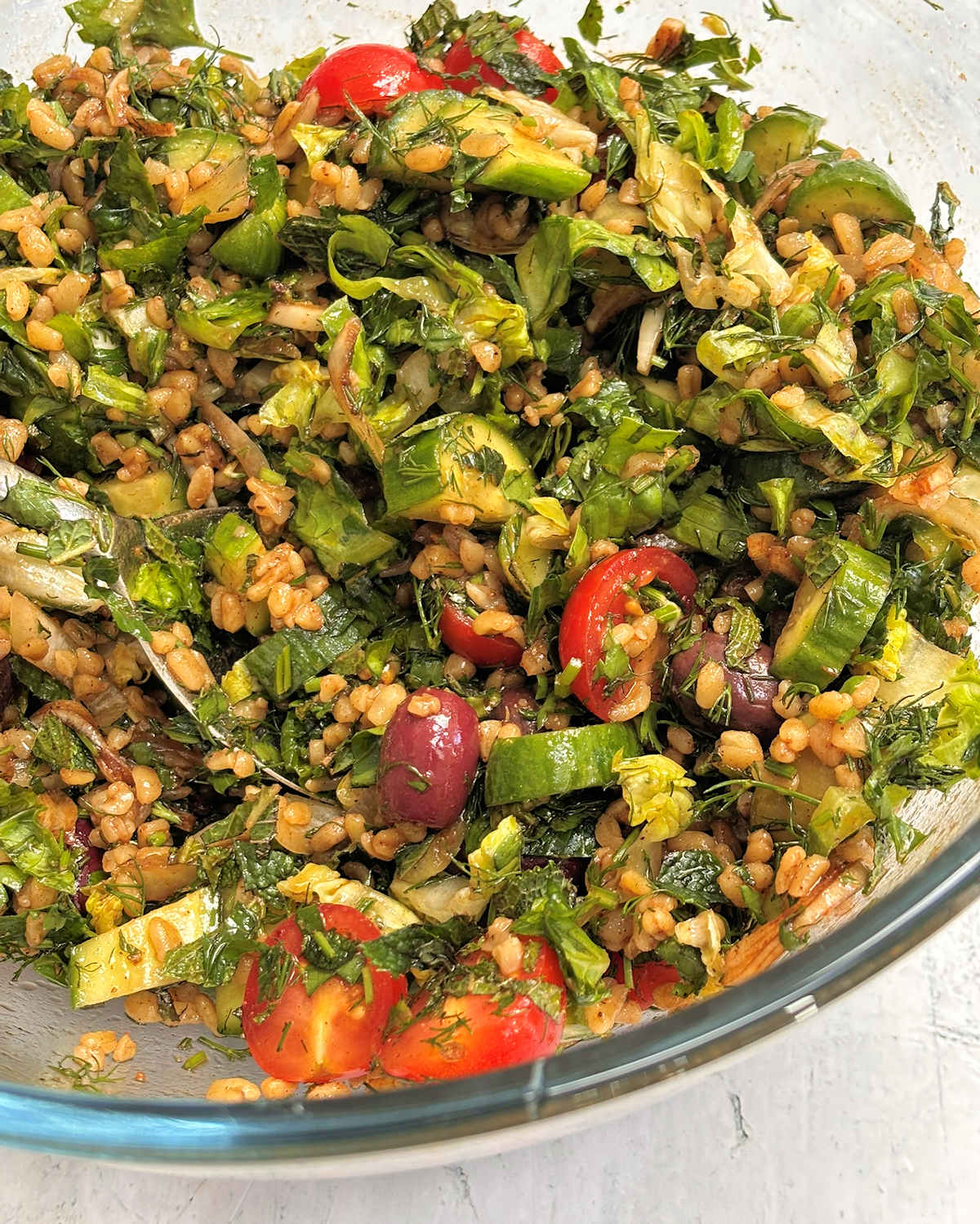
A combo of fresh herbs, tomatoes and cucumbers with a handful of olives and a generous sprinkling of filling bulgur wheat. That’s tabbouleh, and I love it.
Tabbouleh is better than you (or I) thought
Tabbouleh and its various alternative spellings (tabuli, taboulah) is a Levantine salad of green herbs and grains. It features in a Middle Eastern and East Mediterranean meze, or is served as a side dish.
Apparently the key participant in a tabbouleh is parsley, but I like to approach it rather like an Arab equivalent of a Greek salad, with more substance to it than just herbs.
That's because I wasn’t a huge fan of it when I’d encounter it at Turkish or Lebanese restaurants. It always looked to me like there was nothing else in it but chopped up herbs – and even though I’m all for eating healthy, munching on piles of raw parsley and mint is not a delight in my view.
Later on I found that grains are usually added to the salad, bulgur wheat in the traditional version and in the western interpretation sometimes couscous or quinoa (the latter an absolute mistake in my view). And finding cucumbers or tomatoes in it confirmed my belief that tabbouleh must be related to Greek salad.
What type of bulgur wheat?
Allegedly fine bulgur is traditionally added to tabbouleh, but should I trust The Guardian food editor over Yotam Ottolenghi? I thought not.
Ottolenghi seems to prefer coarse or extra coarse bulgur – which is also always my choice. Fine bulgur is like couscous: it goes absolutely everywhere in the kitchen and it’s difficult to make such tiny grains absorb any flavour.
How to prepare coarse bulgur
Coarse bulgur is a substantial bite, similar to pearled spelt or barley. But it’s as easy to prepare as the finer grain: all it needs it a good soak in boiling water, with pinches of salt and spice.
The ratio of bulgur to water is a bit tricky to get right. In theory it is two parts bulgur to three parts water, or twice as much in weight. And so for half a cup of bulgur three-quarters of a cup of water should be used, or 200 ml of water for 100 g bulgur.
But sometimes it doesn’t want to absorb all the liquid as neatly as rice does, depending on temperature, quality of grain and heaven knows what else, so if there’s water still pooling at the bottom of the pan whilst the grains are ready to eat, go ahead and drain the excess.
What salad ingredients to add?
If you stick to only herbs and greens, your tabbouleh will be, I’m sorry to say, rather unexciting. Parsley and mint are de rigeur but apart from those I definitely reach towards Greek salad. How much more vibrant and rewarding the mix will be with crunchy baby cucumbers, ripe and sweet cherry tomatoes, crisp lettuce leaves and a handful of olives?
Could feta go in too, full-Greek-steam ahead? I think it could but it would alter the flavour of the dressing so this time, no cheese.
Pomegranate molasses dressing
It’s a gorgeous albeit very simple dressing – provided you have pomegranate molasses in your store cupboard. But it has gained so much popularity in recent years that I don’t hesitate to include it, after Ottolenghi’s tabbouleh dressing recipe.
What if you don’t have it and won’t try to source it? The best substitution will be a mix of honey, balsamic vinegar and lemon juice in equal quantities.
Baharat spice mix
Baharat is the common seasoning for tabbouleh and it’s a Levantine spice mix of black pepper, cumin, cardamom and a few more fragrant additions like cardamom and nutmeg.
You can buy it premixed, though inarguably the best flavour will be delivered by whole seeds and berries, toasted and ground by hand. I know it’s a lot to ask so I’m providing a serviceable mix of ground spices in the recipe ingredients below.
How to assemble tabbouleh?
The dressing can be whisked together at the bottom of a large mixing bowl. As you chop up each ingredient, add it in with the soaked and drained if need be, fluffed up bulgur at the end.
Toss the salad thoroughly, scraping to the bottom to mix the dressing in, and transfer to a prettier serving bowl.
How to serve it?
If you’re preparing a full-on meze, it will be one of many dishes – but who does that in everyday life? Whereas tabbouleh is very much an everyday salad, ideal for lunch and good enough for dinner, with some fine flatbreads, pita or focaccia – the last perhaps a geo-culinary mismatch but tastewise, my favourite.
Tabbouleh can also successfully accompany roast and grilled meats, fish or vegetables.
More meze recipes
Baba ganoush, Middle Eastern and Mediterranean dish, is a wonderfully smoky, creamy and smooth dip made with whipped flesh of charred whole aubergine. Aubergine can be roasted in the oven, then skinned and creamed with lemon, tahini and olive oil.
Discover the rich history and versatility of kibbeh pie, a traditional Middle Eastern comfort food loved by many, and try out a tasty recipe for yourself!
Muhammara, roasted red pepper and walnut dip, flavoured with pomegranate molasses and Aleppo pepper flakes. This should be a firm fixture in your next meze!
More salad with grains recipes
Couscous with asparagus chunks, toasted pistachio nuts and fresh herbs, it’s a warm salad of perfectly matching ingredients.
Spelt and marinated courgette salad, with pine nuts and creamy blue cheese dressing. Much easier to cook than rice, more nutritious than pasta, spelt is the future of salads!
Bulgur wheat salad with spicy chorizo and vibrant green runner beans. Lunch or dinner, just add a dollop of yoghurt, fresh mint and dill for perfect Middle Eastern – Spanish fusion.