Krantz cake, also known as babka, is a delightful yeast-leavened cake filled with dark chocolate and pecans, intricately braided and glossy with a sugar glaze.
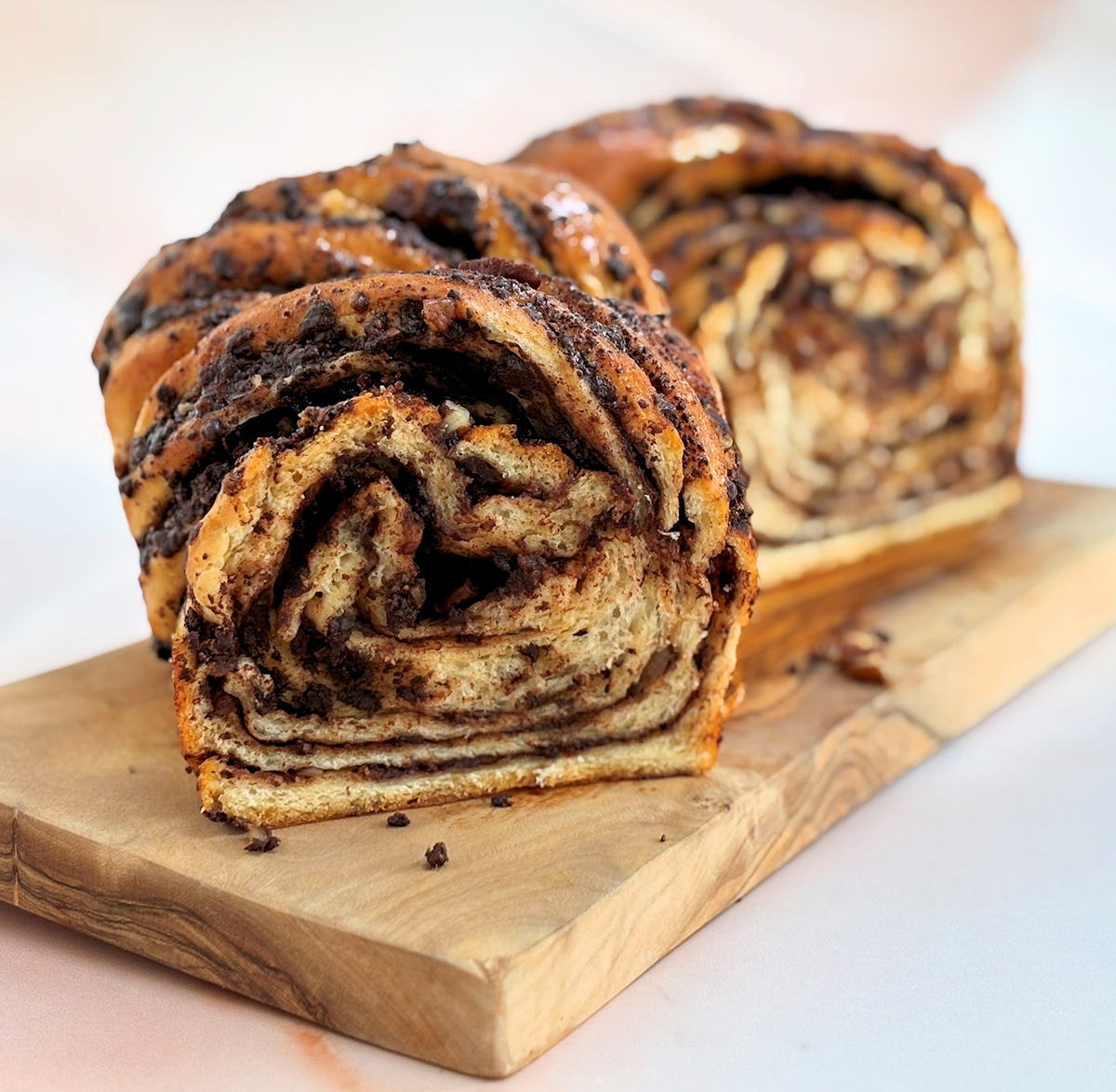
Krantz or babka?
Krantz is a Jewish bread-cake, one of those bakes that tend to be called ‘bread’ purely because the dough is yeast-leavened, but it is a dessert rather than sandwich material.
The origins, as it’s easy to guess, are leftover challah dough filled with a smear of jam, a sprinkling of sugar and cinnamon or a layer of quark cheese. The dough itself is barely sweet, like challah, and even the filling isn’t sickly. The dough strands are plaited like in challah again, but each first rolled up with the filling, then slashed lengthwise before plaiting to expose what’s inside.
Like a lot of Jewish foods krantz gained popularity in America from about 1950s, but there it is widely known by its alternative name derived from Polish: babka (meaning ‘Grandma’). It is the same bread, but the word probably a little easier on the tongue for English speakers than ‘krantz’.
And so it’s ‘krantz’ in Germany and Israel and ‘babka’ in America and wherever else it may be baked (Canada too - thanks to Zosia for the recipe inspiration). The chocolate filling is most probably an American contribution.
The babka conundrum
But interestingly, in Poland I knew ‘babka’ as a sweet yeast-leavened bread baked in a brioche-shaped or bundt tin; often studded with raisins but not filled or braided. I remember being quite surprised when first encountering the Jewish American versions, for which Jewish Ashkenazic cuisine adopted the ‘babka’ name.
And that’s even though – yet more interestingly – the Polish do have a similar bake, rolled and braided though perhaps not as intricately, called ‘strucla’. It is commonly filled with poppy seed or curd cheese rather than with cinnamon, and never with chocolate. It is baked as a free-standing loaf on a tray, not in a tin. I wonder why the Jewish diaspora borrowed ‘babka’ for their bakes and not ‘strucla’? They probably liked the sound of it better.
But whether you call it babka or krantz – the latter my choice for this recipe since, thanks to my heritage, babka to me is the Polish raisin brioche – it’s equally delicious.
How to make the dough
The short answer is: with a standing mixer. But that’s a little arrogant of me, though truth be told, those serious about bread and baking usually own one.
It is quite easily doable without a machine too, the ingredients need to be first worked into rough dough with a wooden spoon, then elbow grease applied into kneading on a lightly floured surface. It does get into the smooth, elastic ball that isn’t sticky any longer after about half an hour of kneading. The machine will achieve it in about ten minutes.
The dough now goes into the fridge for overnight (if possible) rest. It splits the work as well as allows for rolling the dough out the next day more easily. You wouldn’t want to attempt it with a puffy, fluffy pile at room temperature. Like with brioche, the dough is best shaped when well chilled.
Chocolate filling
This is very clever: instead of melting the chocolate and risking a mess, a leak and general unruliness, here it is grated or even better, blitzed in a blender or a food processor to coarse crumbs. The addition of butter makes it stick to the dough better, because dark chocolate which is used here is not very soft.
Its cocoa content will ideally be 60-65%. Higher than that might make the cake a little bitter: don’t forget there’s not much sugar in the dough and none in the filling, bar from the chocolate.
Give the butter a brief spell in the freezer to make sure it won’t turn the chocolate to a paste. Once blitzed, keep the chocolate granules at room temperature.
How to shape krantz
The shaping, admittedly, takes a little practice but even if it turns out awfully messy and not at all tidily plaited, it doesn’t matter a jot – it will still be delicious and look decorously twisty-twirly in a cross section.
Cold dough is easy to roll out, just make sure to dust it and the surface with flour as necessary. Aim for about 30 x 35 cm rectangle but it really isn’t that strict. I know from experience the braided loaf always ends up longer than the tin and needs to be bunched up to fit.
The chocolate granules should be sprinkled evenly over the dough, all the way to the edges, otherwise the ends will be dry and plain. Roll it up as tightly as you can, pressing the filling into the dough.
Then the tricky moment: cutting it through the centre, with a sharp knife or a pastry cutter (or a dough scraper, or a bread knife). Unless you’re every lucky, the layers will unfurl making the handling of those strands not easy. Arrange them into a cross, then overlap the ends over each other or twist them into a spiral. You can tidy it up once it’s twisted so you can grab it and transfer into the tin.
Finishing stages
Proving shaped krantz will take about one and a half hours, until twice the volume. Baking should take about forty minutes until golden brown, risen and impressive.
And do not skip the glaze, it’s the signature look and it helps keep the krantz soft and fresh for a couple of days.
Variations - cinnamon version
The chocolate krantz is only one of the possible fillings. The traditional was probably filled with jam, some East European versions have sweet curd cheese or poppy seed filling, and I absolutely love the cinnamon variety.
It’s very simple. Brush the rolled out dough generously with melted butter, and sprinkle with a mix of coarse sugar and cinnamon, as much as you like. Then roll up, slash in half and braid like the chocolate one.
It is delicious, though not as moist, but it still keeps quite surprisingly well for a yeasted cake.
More sweet bread recipes
Cinnamon twist star bread, inspired by kanelbullar, Swedish cinnamon buns. A giant kanelbulle twisted into a star bread shape, with cinnamon, apple and chocolate fillings. It tastes as good as pretty it looks!
Chocolate braided bread, made from two-coloured dough. This braided chocolate brioche is similar to a chocolate babka, braided and cut to reveal the coloured swirl. Chocolate brioche braid can also be shaped into a wreath.
Schiacciata con l'uva (pronounced ‘ski-a-charter’ and meaning 'squashed'), Tuscan grape focaccia is a sweet version of the Italian flat bread, with grapes and raisins.
More Jewish baking recipes
Challah (pronounced 'khola:) bread recipe, for traditional Jewish holidays. Challah makes the best French toast but when fresh, it's delicious just with butter.
Kubaneh, Yemeni Jewish bread traditionally baked slowly overnight, is the original croissant except with none of the hassle and lots of fun in the making.
Honey cake with dates and apples from Nigella Lawson’s collection is not only suitable for Rosh Hashanah: it’s simply the perfect autumnal cake.