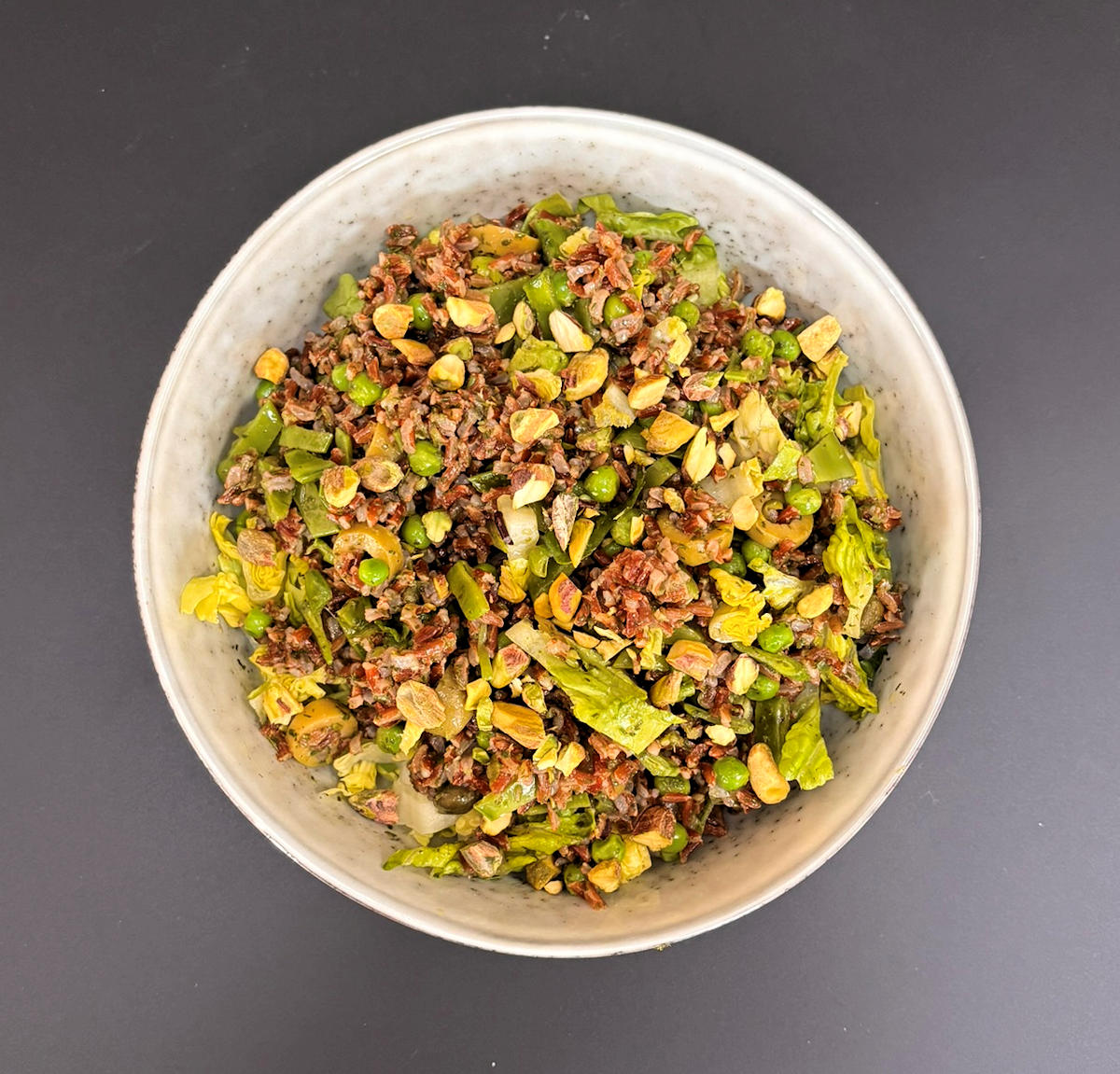
It’s wholesome, nutritious, easy to prepare and extremely tasty – and that’s just the red rice! The salad with crunchy fresh peas, beans, olives and skinny green goddess dressing is absolutely fantastic.
What’s Camargue red rice?
It’s a variety of rice that grows in the South-West of France, in the wetlands of Camargue. It has a protected indication (IGP) meaning only rice grown in that region can be sold as Camargue red.
It is a relatively recent variety, created at the end of the twentieth century from crossing native wild rice growing in Camargue marshes with white rice. Which is interesting, since you might think (as I did) that it must be an ancient grain milled in Gaul by Asterix and his mates. Surprise! It’s a thoroughly modern mutation, none the less worth tasting.
What does it taste like?
It is nutty, flavoursome and aromatic. It has a bite like brown basmati and holds its shape better than standard fluffy white. It is much more expensive than common rice varieties but it’s worth splashing for an occasional treat, especially that it’s a nutritional marvel. Being only rudimentarily processed, with just the outside husk removed, it’s a true whole grain high in fibre. It is also rich in vital minerals and anti-inflammatory flavonoids.
Camargue paddy fields yield white and brown rice varieties as well but the red one is truly unique.
How to cook Camargue red rice?
Without question, the best method is to cook it like pasta: in a large pan of salted boiling water, on a rolling boil. It doesn’t not need to be rinsed beforehand, let alone soaked.
Twenty minutes will produce slightly al dente grains, perfect for salads like this one but also for serving as a side, with a swirl of butter and a pinch of Camargue salt.
If you cook it in a rice cooker, it will be mushy. If you simmer it on low heat, it’s a faff with volumes and ratios. Cooking it in ‘big water’, as I call it, then draining, is the most straightforward.
The (skinny) green goddess dressing
I won’t lie – this is a recipe from Serious Eats with a few tweaks and swaps.
I am normally not a huge fan of herby dressings. I like my herbs in sensible (English) quantities. Chimichurri or chermoula are not my jam and sabzi khordan or tabbouleh are only good if copious amounts of cucumber (in the case of the former) or bulgur wheat (the latter) are added. Pesto is fine on pasta and salsa verde in tacos.
So I was never much interested in green goddess dressing/sauce which in the classic form is lots of herbs blitzed with lemon juice and mayonnaise.
But as it turns out, even something you don’t particularly love in a correct combination can mightily surprise you, as this dressing in this salad did me.
I keep it skinny though, with only lemon juice to loosen it and no mayo. Or anchovies for that matter, to keep the salad vegan.
The base is roughly chopped herbs, and the mix is entirely up to you. I like tarragon, dill and parsley, but only parsley can be used, or coriander if you like it.
They are blitzed with a roughly chopped mild chilli, green to stay in the hue, jalapeño or similar, de-seeded. Continue processing with a pinch of salt, extra virgin olive oil, some honey and as much lemon juice as needed to make it a saucy consistency. If you’d like to make double the amount, the leftovers will keep in the fridge for a good few days.
How to make the red rice salad
When the rice is cooked and drained, the green vegetables can be added in.
I recommend peas: if fresh, delicate garden peas, use them raw. If frozen, thaw them by rinsing with boiling water. Alternatively you can add them to the cooking rice just before draining it.
Sugar snap peas or mangetout, or very tender French green beans should go in raw as well – this salad is about fresh crunch. Slice them thinly and they will soften ever so slightly in warm rice.
Then you can fold in the dressing, because any dressing is always better absorbed by a warm base.
All the other ingredients, chopped olives, capers, shredded lettuce and pistachios should be stirred in just before serving.
Variations
This is an excellent salad even if you don’t get hold of or won’t splash on Camargue rice. You can use a mix of basmati and wild though that’s also a pricey option. On a budget, make it with brown rice, cooked in your usual way, as long as it’s not sticky and has a little bite.
The choice of herbs for the dressing is yours, as mentioned, and instead of extra virgin olive oil you can use walnut oil.
The fresh vegetable element is flexible too: in season asparagus will be delicious. Finely shredded new season cabbage will work instead of lettuce, and if you don’t like olives or capers, just omit them.
More rice recipes
Wild rice with sautéed king oyster mushrooms is an exquisite treat of earthy flavours, chewy textures and a burst of nutritional values. It doesn’t taste like rice – because it isn’t rice.
Persian rice with broad beans, baghali polo, is fragrant, green and yellow with dill and saffron. It’s a classic Iranian side dish for lamb shanks but who cares about lamb? Baghali polo is all you will want.
Oven baked chicken rice pilaf is an easy dinner: a one pot casserole ready in total of forty-five minutes. Chicken never lets you down, does it?
More grain salad recipes
High-protein spelt and edamame power bowl recipe: a fibre-rich, low-GI lunch with avocado, egg and sauerkraut that keeps you full until dinner. It’s an easy meal-prep, endlessly adaptable and ready in minutes.
Tabbouleh, a classic Levantine salad, is a mix of herbs, tomatoes, onions, cucumbers and soaked bulgur wheat, dressed with olive oil and seasoned with Baharat. It’s delicious and healthy, and super easy to prepare.
Couscous with asparagus chunks, toasted pistachio nuts and fresh herbs, it’s a warm salad of perfectly matching ingredients.