Scottish morning rolls, aka softies, aka Glasgow rolls are the northern counterpart to English baps. Soft crumb and a crust sturdy enough to hold a slice of haggis or black pudding for yer scran.
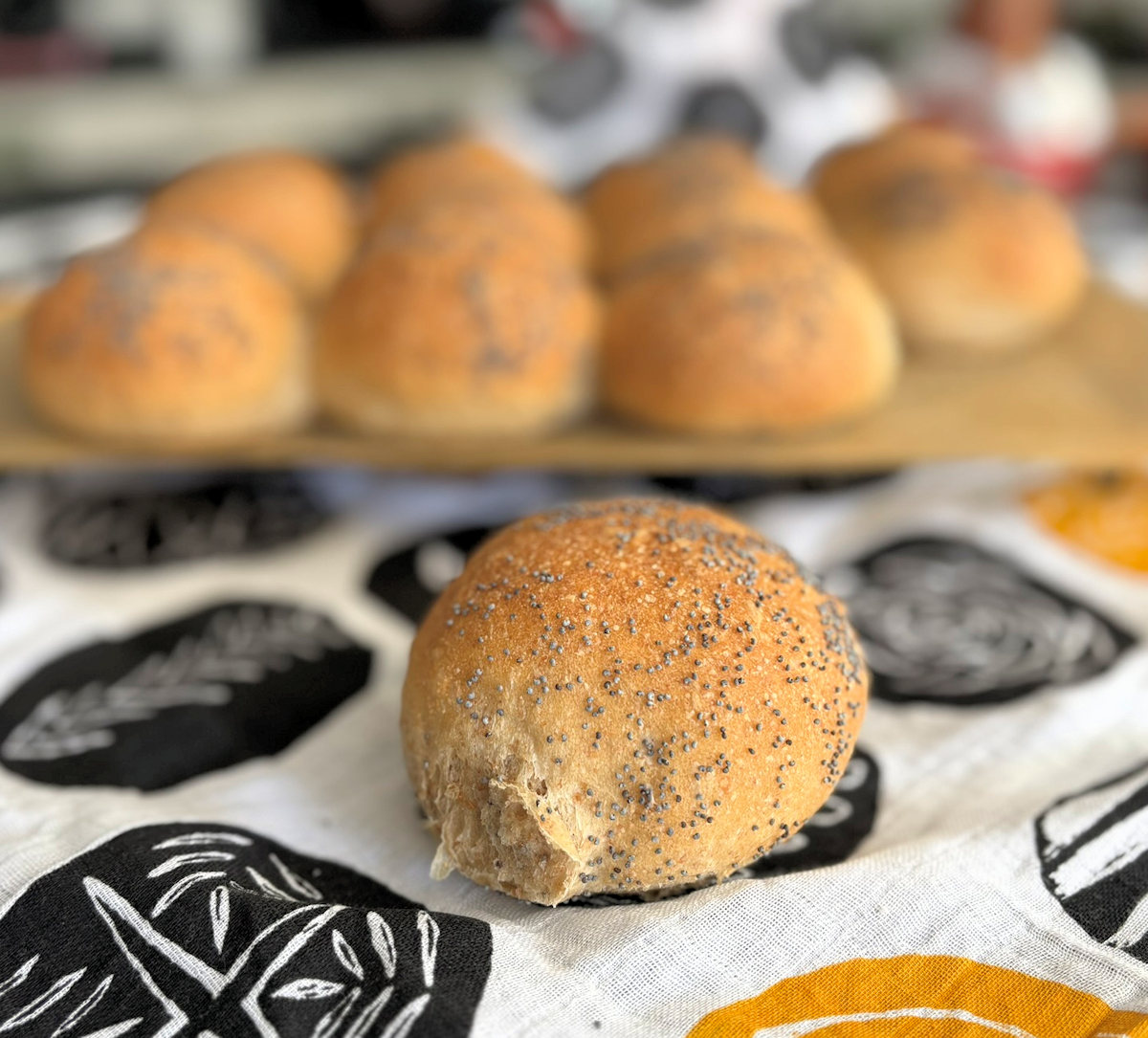
What are Scottish morning rolls?
They are like a sturdier version of baps. It figures: you have to be sturdy if you live in Scotland! Softie, squidgy and floppy English baps are not up to housing Lorne sausage, tattie scone or both. So they are soft and fluffy inside but the crust is more robust, though nothing like crusty sourdough or European-style rolls.
They are very tasty and remain fresh for longer than baps, due to a long fermentation of a starter dough aka sponge. It’s kicked off with yeast, but a very small amount. Left to ferment for up to twenty-four hours, it develops natural active yeast capable of lifting the whole batch of dough, as well as acquiring deeper flavour.
They can be made from all-white flour or as a wholemeal version, like in the recipe below.
But the best thing is they are really easy to knock out in a batch on a morning – provided you’ve remembered to mix the sponge the previous day.
My recipe is slightly tweaked Andrew Whitley’s from Bread Matters: using beer instead of water for a maltier flavour and adding a little honey, which I believe is the Edinburgh bias.
The sponge
All the sponge really requires you to do is remembering to mix it in the evening. A small amount of flour and water with just half a teaspoon of instant yeast – or a crumb of the fresh yeast if you have any – roughly mixed in a bowl is all it takes. Covered, it should sit in the kitchen overnight, for up to eighteen hours.
Do not be tempted to put in more yeast: the small amount combined with long fermentation is sufficient, as during that fermentation natural, wild yeast spores will join in to make a sponge strong enough to lift the whole batch of rolls.
The sponge will become airy, swollen and have a wet appearance. It will rise but might have almost collapsed again if left for longer than twelve hours, which is the minimum.
The dough
The next day the sponge is mixed into the main dough ingredients: both types of flour, beer or water, salt and a little fat, be it butter, lard or duck fat. They are Scottish, don’t forget: none of that olive oil Mediterranean nonsense!
If you have a standing mixer or some type of a ‘kneading appliance’, it’s a very easy job. But the dough is accommodating enough to knead it by hand, taking care not to add more flour. It will stop being sticky after about fifteen minutes of action, and less than half that time in a machine.
Off it goes then to a warm place to prove in bulk, covered, for an hour or until it has doubled in volume.
Shaping and baking
Arguably, shaping is the least easy element of the process, but you needn’t aim for perfection since Scottish rolls are supposed to be far from it and rustically squat. Plus, you can bake them arranged quite close together to be torn apart, so the individual shape matters less.
Either way, try to shape balls with taut surface and arrange them on a baking tray, more or less spaced apart, as the space on the tray allows.
Shaped – and my poppy seed sprinkle is completely un-Scottish and optional – they need to prove again, covered loosely, until puffed up and almost touching.
They go into a hot oven. Traditionally they were baked in a roaring blaze of the baker’s oven and so the first batch would get burnt on top – which meant thrifty Scots would by no means discard them but call those rolls ‘well fired’. Which means that mine would probably be considered raw by those standards!
How to store them?
They are delicious fresh, but obviously to have them ready for breakfast would require us to keep a traditional baker’s daily routine. Thankfully they keep quite well till the next day and can also be lightly toasted in halves, on top of a toaster or in the oven.
The best approach is to freeze the surplus as soon as they are cool, and defrost as many as you need overnight – they’ll be as nice as fresh.
More bread roll recipes
Best beer and Cheddar bread rolls, and this recipe is truly easy. Turning water into wine? Naah, beer into bread! That bottle of ale no one is keen on can be put to good use.
Bridge rolls or finger rolls are fluffy and soft, rich and almost brioche-like. Fresh yeast, full milk, eggs and butter make them into the loveliest mini dinner rolls.
Old fashioned soft white baps make a nice change from all the crusty French sticks and sourdough. And apparently they are the best housing for a proper bacon sandwich.
More Scottish recipes
Scottish oatcakes, and the best are homemade. These oatcakes are tasty, gluten-free and low in sugar. Oatmeal cookies are definitely the healthiest, and easy to make: just stir all the ingredients together, spoon onto trays and bake.
Arbroath smokie, small Scottish smoked haddock, flaked into a rice pilaf with Middle Eastern flavours. Arbroath smokie rice pilaf is similar to smoked fish kedgeree, and great for lunch or brunch.
Haggis, neeps and tatties, traditional Scottish supper for Burns’ Night: it is the Scottish oat sausage served with mashed potatoes and swede or, in my recipe, carrots.