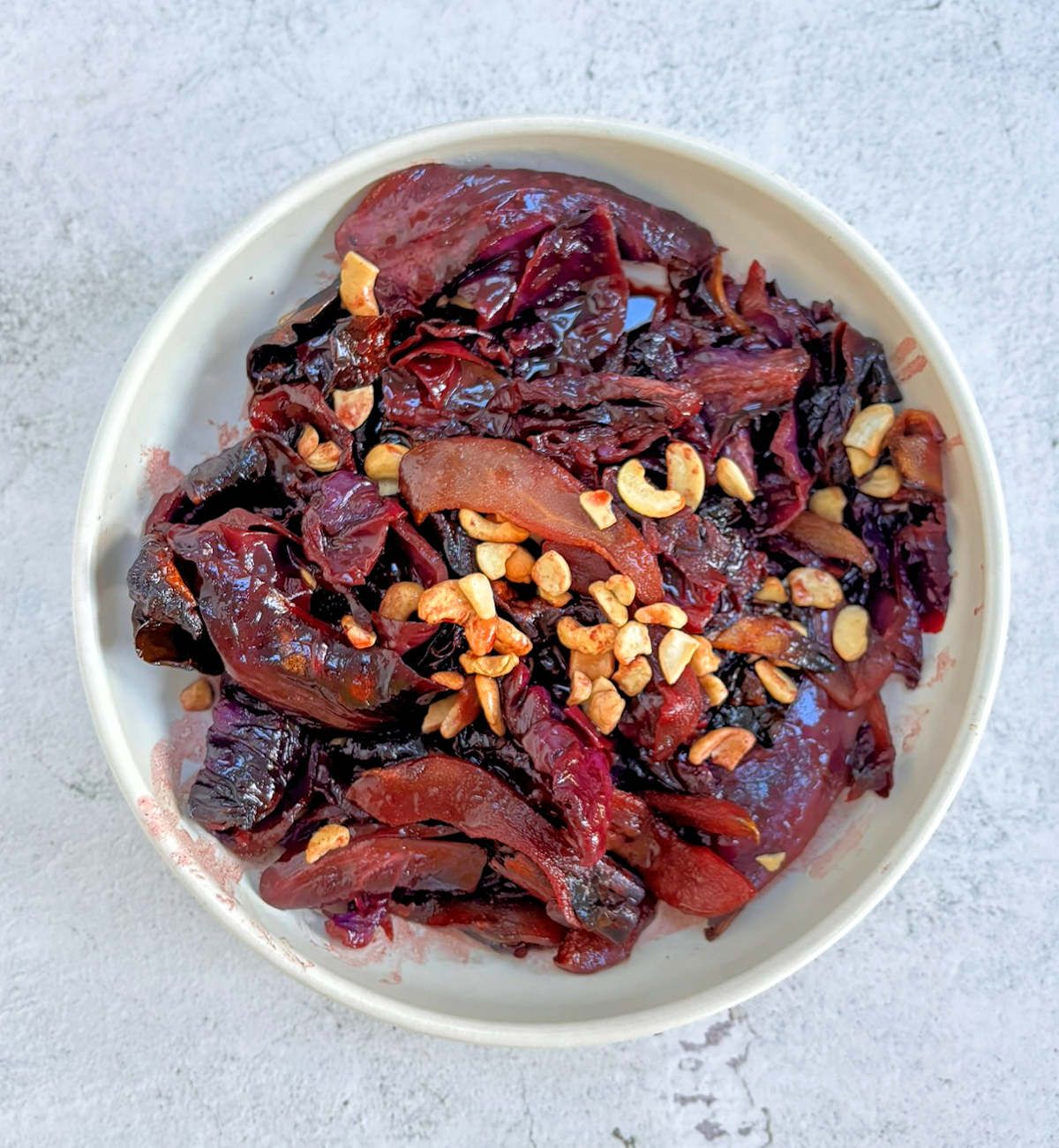
Rich, sweet, tangy and deep purple: this roasted red cabbage dish is so gorgeous you can have it on its own, even though it’s meant to be a festive side.
Red cabbage, white cabbage
Cabbage in general is a very good thing to eat, obviously. Being a plant, rich in fibre and low in calories, it also contains plenty of vitamins, minerals and antioxidants.
Red cabbage is a slightly less popular though certainly a more handsome variety. So how does it compare to the ordinary, white or green brassicas?
That colour is there not just for show: anthocyanins, the pigments responsible for the purple hue, are also antioxidants, clearly missing from the white cabbage. The red one also contains more vitamin B and E, though not C or A. So it’s probably close to a nutritional draw, which only means we should eat cabbage of all colours, for the variety.
Or blue cabbage?
If you’ve never boiled or steamed red cabbage, you might not know how ugly it can become: the beautiful purple turns into dirty blue grey. That’s because cooking red cabbage in a neutral or alkaline environment degrades the pigment, and tap water is very slightly alkaline.
But if you add vinegar or lemon juice to the cooking, the purple tint will remain as vibrant, if not more so. The anthocyanins love acidic environment and will keep the colours flying.
Braising and roasting is safe in that respect. Even if you didn’t add any acid during that method of cooking, the cabbage will remain colourful. Just like in the recipe below, which comes from the Ottolenghi collection.
How to chop the cabbage?
I do love this recipe not least because it avoids laborious shredding of the cabbage. Shredding is bothersome: use a food processor and you have tonnes of washing up. Use a mandolin and it’s too finely shredded. Implement your knife skills, and it’s messy and time-consuming.
This is brilliant: all you need to do is quarter the cabbage, remove the tough core (and tougher outer leaves if necessary), then cut each quarter across in half. You’ll end up with neat cones of cabbage, which you can now separate into more or less individual leaves. If the cabbage head was enormous, you might want to cut it into eights, then halve each eighth. The leaves should be slightly larger than bite sized.
Pile them all into a large bowl.
The seasoning
The way it’s chopped is innovative (in my view at least). The way it’s cooked is moderately novel, as roasting cabbage is becoming more popular these days. And the seasoning is classic with slight twists.
Cabbage, whatever its colour, loves lots of butter – and it is here in copious amounts. I have actually cut down on Yotam’s instruction radically: an almost whole packet of butter for a head of cabbage, that’s a bit too rich, in every sense.
I also decisively cut the sugar amount to a third of the original – and it’s still plenty sweet. Because the acidity is delivered by an ingredient which is also very sweet: pomegranate molasses.
There is extra sweetness added by the caramelised pear slices, and spiciness from cinnamon. And the cashew nut topping makes for the variety of texture.
How to make sweet and sour roasted red cabbage?
To the cabbage leaves in a bowl add the salt, pepper and the sugar. Mix and toss it roughly, then transfer to a roasting tin.
For a standard size red cabbage, use a deep roasting tin 30 by 20 cm, that is 12 by 8 inch. You’ll immediately worry that it’s going to be too small, but no fear. The cabbage will shrink considerably within the first half hour of cooking, and if spread in a larger tray it might well burn in places. Just pack it in with your hands and press down.
The butter and the cinnamon stick can be tucked in at random – the cabbage will get a good stir once it’s wilted. Pomegranate molasses and stock poured in, it can go to the oven for half an hour, uncovered.
While it’s roasting, you can prepare the pears. After the first thirty minutes remove the tray from the oven and mix the cabbage very thoroughly with tongs or two forks. Now top it with the pear slices and return to the oven – this time for 45 minutes.
Time for the second mixing: check if there’s not too much liquid pooling at the bottom of the tray. If it looks watery, roast it for another fifteen minutes until the juices turn into thick sauce.
With the cashew nuts scattered over, it will now need the final fifteen minutes oven time – and it’s ready to toss once more and serve.
More red cabbage recipes
Fermented red cabbage with chillies and ginger, Europe’s answer to kimchi. Red cabbage sauerkraut is made exactly like the white but it’s vibrant and a bit more crunchy.
Festive red cabbage stir fried with apples, raisins and spices, super quick to cook. Red cabbage can be sauteed very quickly and easily, and it's great not only for Christmas.
Vibrant winter rainbow salad with red and green cabbage, red and white onions, herbs and a vegan dressing. It’s a healthy and crisp fresh side salad with crunchy vegetables in vibrant colours.
More festive side dish recipes
Green bean casserole is so good when homemade and cooked from scratch! Creamy mushroom sauce is easy to make, while blanching then drying fresh green beans stops them from being soggy.
Brussels sprout heads and Brussels sprout tops, two side dishes out of a sprout stick. The sprouts are roasted in olive oil until caramelised and gorgeous, and the tops are blanched and tossed with toasted almonds.
Carrots and parsnips roasted with garlic cloves, harissa, herbs and honey, that's a classic trimming for a Christmas dinner. But a tray of fragrant roast vegetables is far too good to only have once a year!